Finding
Planet Nine
Exploring the evidence.
Testing new tools.
Joining the search.

ESA/Hubble’s concept of Planet Nine. Its colour, clouds and appearance are artistic choices, not measured properties. This is not a telescope image or a detection.
Credit: ESA/Hubble, M. Kornmesser · CC BY 4.0Is there another planet out there?
Planet Nine is a proposed planet far beyond Neptune. Its gravity could explain some unusual orbits of small, icy bodies in the outer Solar System. Batygin and Brown set out the modern hypothesis in 2016. No object has yet been confirmed as that planet. [1] [3]
Finding Planet Nine is a personal challenge: understand the evidence, explore public astronomical data, and develop small, testable ways to contribute using AI and new search tools. The evidence guide is live; practical search experiments are the next stage. A better explanation for the clues is a useful result too.
No verified Planet Nine detection in the sources reviewed. Confidence in that status: high. Whether it exists: unknown.
Reported range: 4.9–8.4 Earth masses. A model estimate, not a measurement of a detected planet. [2]
Semimajor axis; reported range 300–520 AU. This is not its current distance or a known position. [2]
The instruments. The sky. The clues.
Explore the hardware and imagery behind the search. Each caption identifies what is observed, processed or illustrated. Select an image to visit its original source.

Rubin’s camera takes its place
The LSST Camera being installed on Rubin’s Simonyi Survey Telescope in March 2025. Repeated imaging makes it possible to search for objects that move against background stars.
Credit: RubinObs/NOIRLab/SLAC/NSF/DOE/AURA/B. Quint · CC BY 4.0
Subaru beneath the northern stars
Subaru’s 8.2-metre telescope combines a large light-gathering mirror with wide-field instruments. Its Hyper Suprime-Cam was used to discover Ammonite, one of the small bodies testing the Planet Nine story.
Credit: NAOJ · NAOJ reuse terms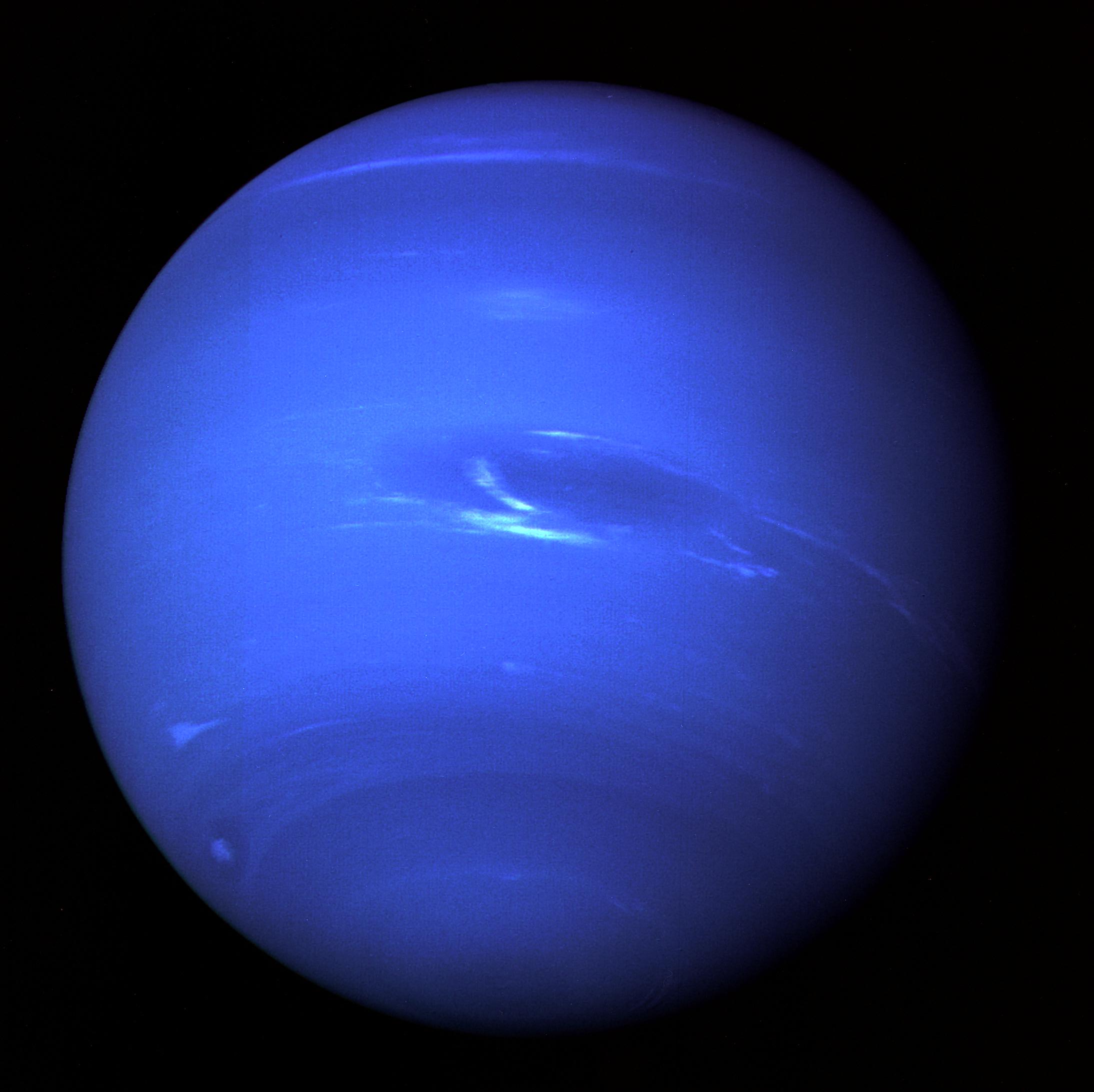
Neptune: a real distant world
Voyager 2’s full-disc view, assembled from filtered images. Neptune is a real ice giant and a useful visual comparison. This processing is not a prediction of Planet Nine’s colour or atmosphere.
Credit: NASA/JPL · NASA/JPL image-use policy
The orbits that complicate the story
NAOJ’s diagram of Ammonite (2023 KQ14) and three other sednoids. The yellow marker shows Ammonite’s July 2025 position. This is a visualisation of inferred orbits, not a photograph of paths in space.
Credit: NAOJ · NAOJ reuse terms
The whole sky, seen in infrared
WISE’s all-sky mosaic, released in 2012. Colours encode infrared wavelengths rather than what human eyes would see. The image shows the survey’s reach; the search for a faint moving object needs the underlying images from different dates. It does not mark Planet Nine’s location.
Credit: NASA/JPL-Caltech/UCLA · NASA/JPL image-use policyImages are shown without added markings or colour changes, and scaled to fit. Source credits and reuse terms accompany every image. No image here is a confirmed view of Planet Nine.
What has changed?
Publication dates appear below. Older research is kept in context rather than presented as breaking news.
Rubin finds 2026 ED138
Rubin announced a distant dwarf-planet candidate, found in a crowded region near the Milky Way. It is not Planet Nine. The relevant advance is the ability to recover slow-moving objects among dense star fields. [10]
A stellar flyby remains in the running
Pfalzner and colleagues modelled how an early close stellar encounter could leave orbital patterns that survive billions of years. Their updated simulations improve some matches to the observed population; discrepancies remain. This is a competing explanation, not a disproof of Planet Nine. [11]
A targeted field comes up empty
A parallax search covered about 98 square degrees and found no credible candidate within its sensitivity limits. The authors report 85% confidence exclusions around r = 21.0–21.4. Fainter objects or other fields remain possible. [7]
“Ammonite” complicates the picture
Subaru’s 2023 KQ14 has a stable, detached orbit that does not align with the other sednoids. Its study favours more distant rather than closer orbits for a hypothetical large planet. A new constraint, not a final verdict. [8]
An infrared lead awaits confirmation
Phan and colleagues identified one promising IRAS–AKARI candidate pair in observations 23 years apart. Those detections cannot establish a full orbit. No confirming follow-up was located in this review; its identity remains unresolved. [6]
Finding Planet Nine begins
Evidence ledger, distance explorer, visual atlas and technology tracker established. The next stage is to test small search experiments and report methods, results and failures openly. No original detection or search result is claimed at launch.
Interesting clues. An unsettled case.
For: orbital structure that a distant planet could produce
The original argument concerns the orientations of some extreme trans-Neptunian objects. A distant planet’s gravity could maintain patterns in their orbits and help explain very inclined and detached populations. The observed objects are real; the inferred planet is a model. [1]
A 2024 study of low-inclination, Neptune-crossing objects found its Planet Nine model fitted the sample better than its no-Planet-Nine comparison, reporting a result near 5σ. That significance applies to the models and assumptions tested. It is not a direct detection or a universal probability that the planet exists. [5]
Against: the sky we search can shape the pattern we find
Surveys differ in where, when and how deeply they look. Napier and colleagues modelled those selection effects for 14 extreme objects from three surveys and found that sample consistent with an underlying population without angular clustering. This challenges a key argument, but the small sample does not exclude every possible distant planet. [4]
The next test: larger samples with documented search coverage and recovery efficiency, analysed consistently against competing models.
Constraints: searches have eliminated possibilities
The 2024 Pan-STARRS1 search, combined with previous ZTF and DES work, excluded 78% of the Brown–Batygin model’s parameter space. The residual possibilities include faint objects and crowded sky regions. [9]
Historical model-specific result, not a live progress bar, a fraction of the whole sky, or a probability of non-existence. Later searches are not simply added to it.
Alternatives: early encounters and a more complicated outer Solar System
A passing star in the Sun’s birth environment could leave long-lasting orbital signatures. The 2026 flyby preprint tests the later evolution of such a population. Ammonite also shows that detached objects need not all share one alignment. These ideas must be tested against the same survey biases and the full range of orbital data. [8] [11]
Far is an understatement.
Choose a hypothetical distance from the Sun. One astronomical unit (AU) is the Earth–Sun distance, about 150 million kilometres. These are learning scenarios, not measured Planet Nine positions.
Select a scenario
Linear distance scale; dots are enlarged. Calculated using 1 AU = 149,597,870.7 km, light speed = 299,792.458 km/s, and Kepler’s approximation P = a3/2 (years and AU). For an eccentric orbit, present distance and semimajor axis a are different.
Why so hard to see?
For the same reflective object far from Earth, received sunlight falls approximately as distance to the fourth power: twice as far means roughly 16 times fainter. Its slow apparent motion and crowded star fields add to the problem.
Movement is the giveaway
Earth’s motion changes the apparent position of a distant Solar System object against background stars. Comparing repeated images helps separate a moving body from stars, galaxies and image defects. The 2026 targeted search used this parallax principle. [7]
Better eyes. Better ways to search.
The opportunity is the combination of deeper, repeated imaging, long archives and faster analysis. Some of this is machine learning; much is careful astronomy and conventional computation.
| Instrument / method | What it contributes | What to watch |
|---|---|---|
| Rubin / LSSTRepeated optical surveys | Large samples of moving objects and repeat visits to crowded fields. ED138 shows the discovery machinery at work. [10] | Well-characterised distant-object catalogues, slow-motion searches and candidate follow-up. |
| Subaru / HSCDeep, wide-field imaging | Reaches faint outer Solar System bodies; the FOSSIL survey found Ammonite. [8] | More detached objects that test which orbital patterns are real. |
| IRAS, AKARI & WISE archivesInfrared searches | Searches for emitted heat complement reflected-light searches. Historical data enable long time baselines. [3] [6] | Recovery of candidate sources at new epochs; a reliable orbit, not just a positional match. |
| Survey simulatorsSelection effects | Sorcha predicts what a survey would detect from a proposed population, allowing fairer model comparisons. [13] | Predictions checked against actual detection and recovery rates. |
Where AI already helps
Classifiers can sift rare moving-object candidates from noisy detections.
Orbit-fitting algorithms connect observations across nights. Not every algorithm is AI.
Statistical emulators make expensive dynamical calculations easier to search.
New observations and independent checks decide whether a candidate survives.
A fivefold speed-up in one test
Henghes and colleagues used a random-forest classifier on simulated TNOs mixed with real DES noise. Pre-selection made the orbit-fitting stage five times faster in that experiment. It did not discover Planet Nine. [12]
Machine learning in the orbit inference
Brown and Batygin used a Gaussian-process emulator with simulations and statistical sampling to estimate possible Planet Nine parameters. The result depends on the hypothesis and data; it cannot establish existence on its own. [2]
Potential next gains: better classification in crowded fields, efficient searches through archival images, and faster model comparisons. These are opportunities to monitor, not a promise that generative AI will find a planet. The key benchmark is recovery of real or injected faint objects without excessive false positives.
The background, without the hype.
What do the orbital terms mean?
TNO: a trans-Neptunian object, orbiting beyond Neptune. Perihelion (q): the point or distance of closest approach to the Sun. Aphelion: farthest approach. Semimajor axis (a): half the long axis of an ellipse; it sets the orbital period. Inclination: the tilt of the orbital plane. Albedo: how much incident light a surface reflects.
A sednoid is a member of a small class of very distant, detached objects named after Sedna. Their orbits help test the Solar System’s early history. [8]
Would it be a super-Earth, an ice giant—or something stranger?
A several-Earth-mass body could help fill a size/mass category common in other planetary systems but absent among our eight recognised planets. Its atmosphere, surface, radius and colour are unknown. “Super-Earth” describes a mass or size category, not an Earth-like climate. Any picture of Planet Nine’s surface or clouds is an artist’s impression. [3]
A captured primordial black hole has also been proposed as a speculative gravitational alternative. That paper is not evidence that such a black hole exists here. [14]
How could a planet have ended up that far away?
Why doesn’t an empty search settle it?
A null result rules out objects only within the survey’s footprint, brightness sensitivity, time coverage and motion-selection limits. A distant planet might be fainter than assumed or outside the field. Conversely, enough well-characterised null results can make a particular model increasingly difficult to sustain. [7] [9]
Can anyone help?
NASA’s Backyard Worlds: Planet 9 citizen-science project uses WISE images to search for nearby moving objects. Its name is not a claim that Planet Nine has been found. The NASA overview links to the project and explains the search. [3]
What would count as a meaningful breakthrough?
A recovered candidate with repeatable motion and a distant orbital solution; independent follow-up; a much larger, bias-corrected sample that strengthens or erases the predicted orbital structure; or a search that excludes a substantial, clearly defined set of remaining possibilities. A press headline, simulation or single unexplained point of light is insufficient.
What would change the picture?
- Candidate recoveryFollow-up of the infrared lead with enough observations to fit and test an orbit.
- Rubin’s distant-object censusSelection-aware tests of orbital clustering, including objects missed in crowded fields.
- New null resultsDepth, footprint and completeness—not headline percentages alone.
- AI with measurable gainsPublished recovery rates, contamination rates and computing cost on real astronomical data.
- Alternatives tested fairlyComparisons using the same observations, survey biases and clearly stated assumptions.
Read the underlying work.
Primary research and official observatory material. arXiv links provide accessible manuscripts; publication status is labelled where relevant. This is a curated starting point, not an exhaustive bibliography.
- Batygin & Brown (2016), Evidence for a Distant Giant Planet in the Solar System — the original modern hypothesis; Astronomical Journal.
- Brown & Batygin (2021), The Orbit of Planet Nine — model parameters and Gaussian-process inference; Astronomical Journal.
- NASA, Hypothetical Planet X — overview and citizen-science links. Some historical/telescope scheduling text is dated; use current observatory releases for operations.
- Napier et al. (2021), No Evidence for Orbital Clustering in the Extreme Trans-Neptunian Objects — the selection-bias challenge; Planetary Science Journal.
- Batygin et al. (2024), Generation of Low-Inclination, Neptune-Crossing TNOs by Planet Nine — a distinct dynamical test; Astrophysical Journal Letters.
- Phan et al. (2025), A Search for Planet Nine with IRAS and AKARI Data — unconfirmed infrared candidate; PASA 42, e064.
- Socas-Navarro & Trujillo (2026), A Targeted, Parallax-Based Search for Planet Nine — published 6 January in The Open Journal of Astrophysics; accessible manuscript.
- Subaru (14 July 2025), Discovery of “Ammonite” — official explanation; Chen et al., Nature Astronomy.
- Brown, Holman & Batygin (2024), A Pan-STARRS1 Search for Planet Nine — model-specific 78% exclusion result; Astronomical Journal.
- NSF (27 October 2026), Rubin’s new dwarf-planet candidate — official ED138 announcement; Rubin’s detailed release.
- Pfalzner, Wagner & Bischoff (3 September 2026), TNO dynamics after a stellar flyby and 4.5 Gyr of evolution — preprint; peer-reviewed publication not verified in this review.
- Henghes et al. (2021), Machine Learning for Searching the Dark Energy Survey for Trans-Neptunian Objects — PASP 133, 014501; preprint first posted in 2020.
- LSST:UK (6 June 2025), Sorcha survey simulations — forecasts and observational selection effects.
- Scholtz & Unwin (2020), What If Planet 9 Is a Primordial Black Hole? — speculative alternative; Physical Review Letters; preprint first posted in 2019.